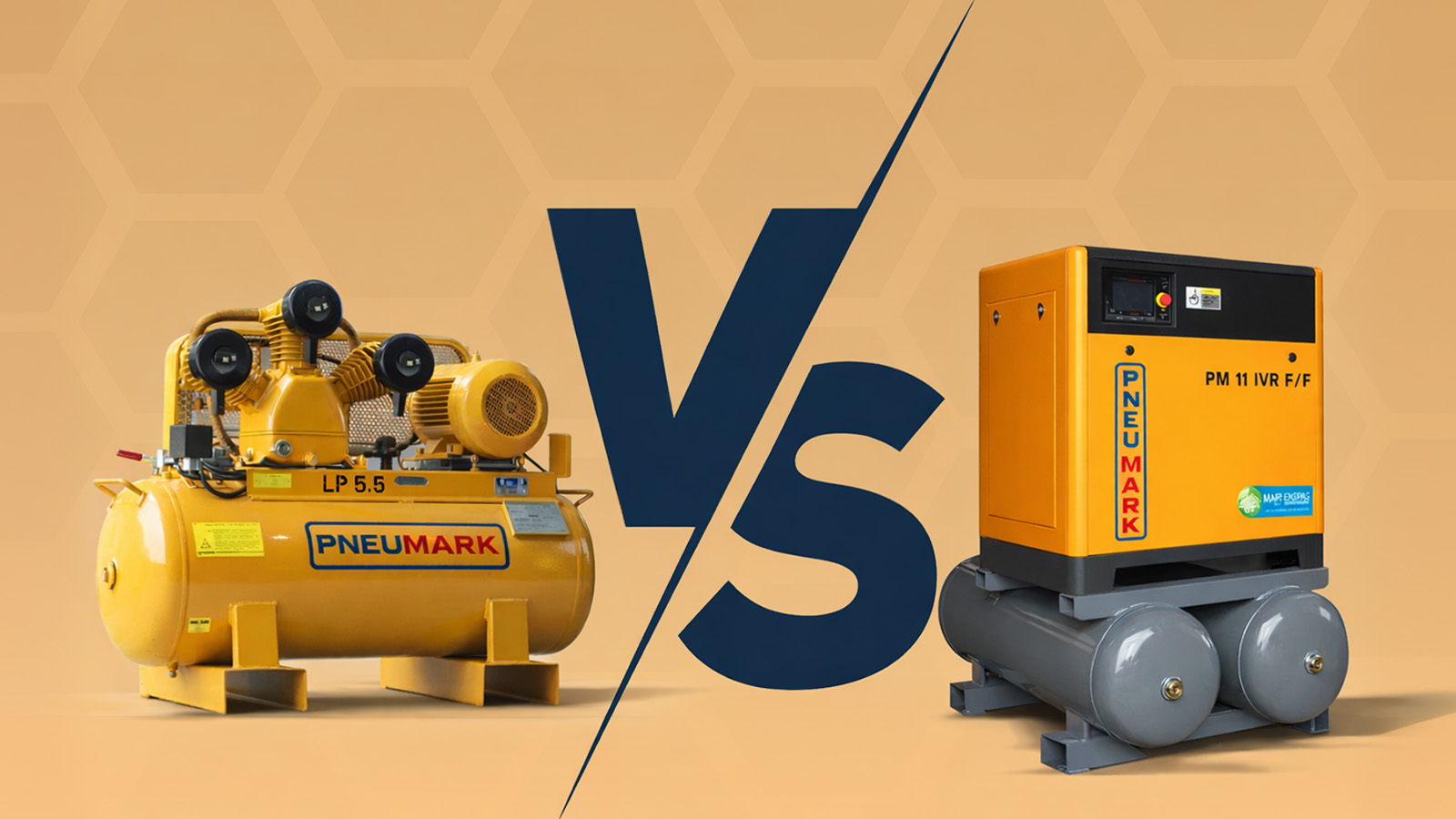
Air compressors are among the most important assets at manufacturing facilities, workshops, and industrial plants. They power a wide range of pneumatic tools and equipment, ensuring uninterrupted operations.
Confused between screw and piston air compressors? Don’t worry, we are here to help. Read this blog until the end to learn all about it.
Before getting into the distinction between screw and piston compressors, let’s first take a look at what an air compressor is.
It is a mechanical device that converts power into potential energy. This potential energy is stored in compressed air form inside metal or alloy tanks.
The physics behind an air compressor’s functioning is simple. It increases the air pressure by decreasing its volume. This high-pressure air is effective in powering a wide range of pneumatic tools at minimal cost.
Intake, compression, storage, and discharge are crucial aspects of the air compression process. Depending on the type of air compressor, the intake and compression techniques vary.
Cost is the most important factor to consider when making business decisions. When choosing between screw and piston air compressors, you must mainly consider two costs: initial and operating. One of the primary mistakes businesses make is not considering the latter.
The duty cycle directly influences an air compressor’s efficiency. It is the percentage of time a compressor can operate before the mandatory resting period needed to prevent overheating.
The duty cycle is usually calculated over 10 minutes. If an air compressor works for 7 minutes and rests for 3 minutes, it has a 70% duty cycle. A screw compressor, designed for 24×7 operations, does not need to cool down and has 100% duty cycle.
Measured in Cubic Feet Per Minute (CFM), the capacity of air compressors is an important factor to determine while choosing between screw and piston air compressors. Piston air compressors are perfect for low-volume applications. Screw compressors are perfect for consistent air flow.
Screw air compressors are your best friend if you are looking for a low-maintenance option. A piston air compressor has more moving parts. Meaning, it is more prone to damage and demands more maintenance and care. When the screw compressor does demand repairs, it could be slightly more expensive. However, the lower maintenance costs more than make up for it.