


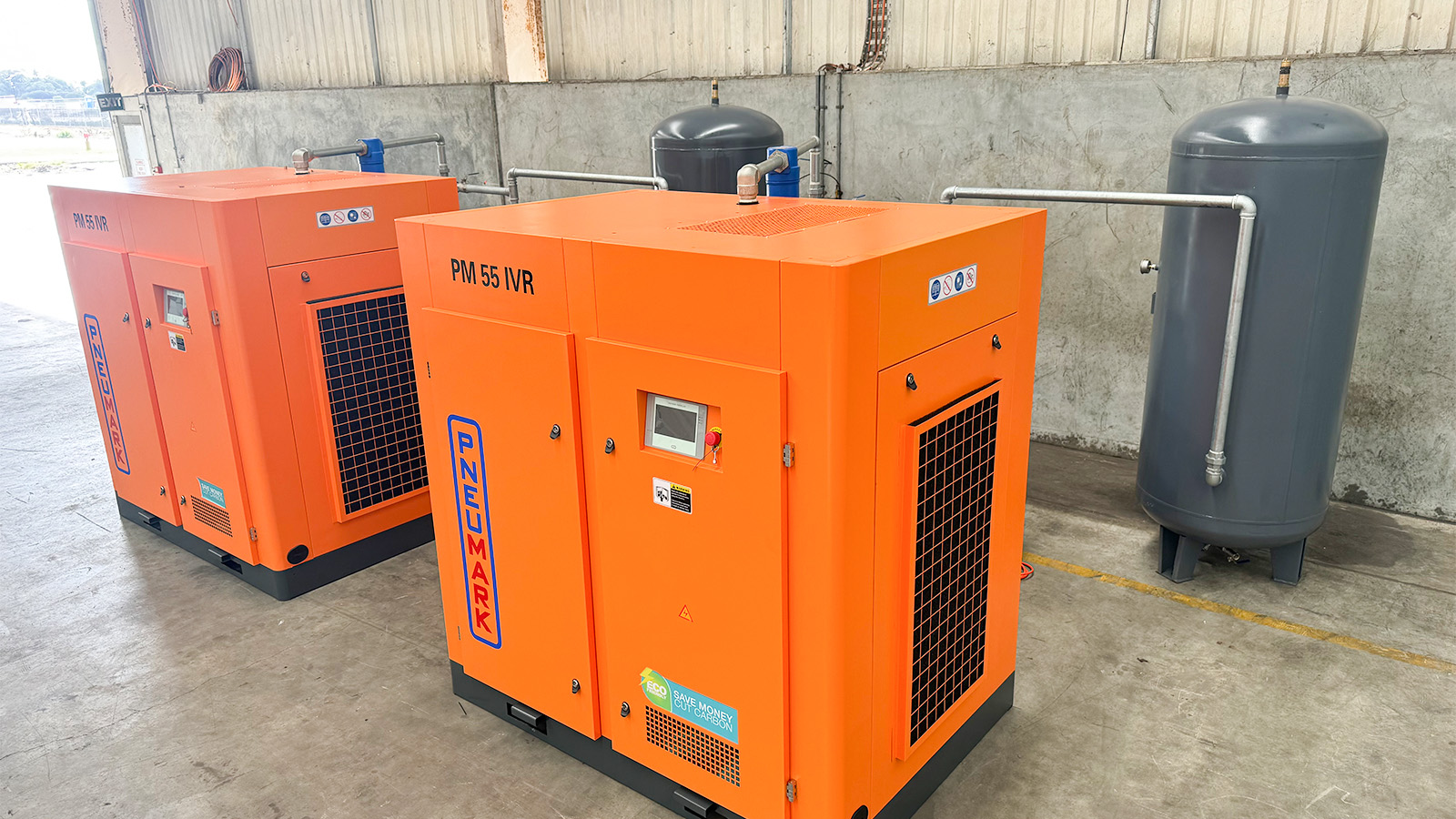
At SL Engineering, we get this question many times: Does a rotary screw compressor need a tank? We hear it in real conversations on-site, more than you’d think.
Short answer — no, it doesn’t have to. Real-world answer? It usually runs better with one.
There’s a difference between what a machine can do and what actually works best once it’s bolted into a workshop or industrial site.
A rotary screw compressor doesn’t “pulse” air the way older piston units do. Instead, it pulls air in and traps it between two rotating screws, compressing it as it moves through. That’s what defines a screw air compressor. Smooth output. Continuous flow. No gaps in delivery.
It’s why they’re used in demanding environments where airflow can’t afford to drop off mid-task. But here’s the catch — just because the air coming out is steady doesn’t mean the demand is.
Technically speaking, it can run without one.
Modern industrial screw air compressor systems are designed to handle direct delivery. Some even use variable speed drives to match output closely to demand.
So yes, it will work. But “working” and “working well under changing load conditions” are two different things entirely. And that’s where things usually shift in favour of a tank.
On paper, the compressor just supplies air as needed. But on-site, demand changes constantly. Someone hits a blowgun. A machine starts up. Another tool cuts out. Air usage jumps around in ways no compressor can perfectly predict in real time.
Without storage, the system has to react instantly to every change. That’s where you start seeing pressure dips, more frequent cycling, and a system that feels like it’s always catching up.
Nothing dramatic. Just small inefficiencies that build up over time.
An air receiver doesn’t create pressure — it evens it out.
It holds compressed air, so the system has something to draw from when demand spikes. Instead of the compressor reacting immediately to every change, the tank absorbs those short bursts.
Then the compressor refills it in the background. That simple shift changes how the whole system behaves. Less scrambling. More stability.
In practice, most screw air compressor setups we see around Perth still include a tank. Not because it’s mandatory, but because it solves everyday issues. For instance:
Tools and machinery respond better when pressure isn’t swinging up and down.
Without storage, the unit cycles more often. With a tank, it runs in a more controlled rhythm.
Instead of the compressor instantly ramping up, the tank absorbs the load for a moment.
Compressed air always carries moisture. A tank gives it time to condense before reaching the equipment.
None of this is theoretical — it shows up in day-to-day use.
There are some setups where a tank isn’t essential. Compact systems, space-limited installations, or carefully engineered variable speed systems can operate without a traditional receiver. In those cases, the compressor is tuned closely to match demand patterns.
Even then, it’s not really “no buffer”— it’s just built differently. And in many cases, a small receiver still ends up included somewhere in the line anyway.
Across industrial sites in greater Perth, the pattern is fairly consistent. An industrial screw air compressor is rarely running in a perfectly stable environment. Usage changes throughout the day. Different tools draw different loads. Production demands shift without warning.
That unpredictability is the real reason tanks stick around. Not because the compressor can’t cope — but because the system runs more smoothly when it’s not constantly chasing demand changes in real time.
For Perth businesses in trade, fabrication, automotive, and mining support, compressed air is tied directly to productivity. When pressure is steady, work flows. When it isn’t, everything slows down—sometimes subtly, sometimes noticeably.
A tank doesn’t fix everything, but it removes a lot of the small fluctuations that cause frustration on site. That’s usually why most installations we work on still include both a screw air compressor and a receiver tank as a standard pairing.
Final Thoughts from SL Engineering
So, does a rotary screw compressor need a tank? No, not strictly.
But in most real-world industrial setups, it makes sense to have one. The compressor produces air continuously. The tank helps the air behave in a way that suits changing demand.
One handles production. The other smooths the delivery. And in practical terms, that combination is what keeps most systems stable, predictable, and easier to run day after day.