


Most people know what an air compressor does — they don’t always know what’s inside one.
And honestly, that’s fair enough. If the machine starts every morning, builds pressure, and keeps the workshop or production line running, there usually isn’t much reason to think about what happens under the covers. Until there’s a problem!
That’s often when people start learning how many different components are involved in producing compressed air. More than you’d think, actually.
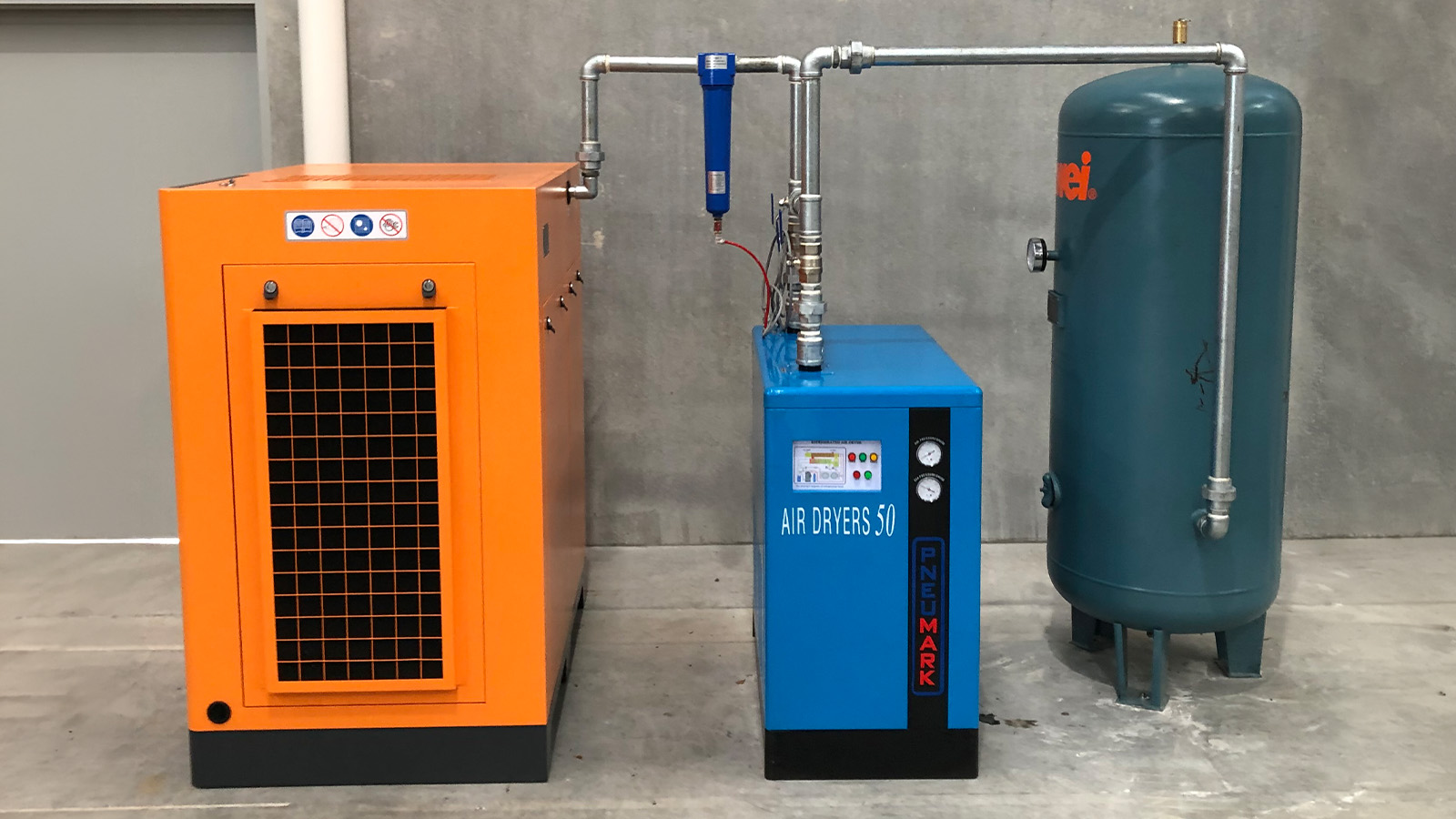
A modern compressed air system isn’t simply a compressor. It’s a collection of components working together to compress, store, treat, and deliver air where it’s needed.
Some parts do the heavy lifting. Others work quietly in the background. Every one of them matters.
Let’s take a closer look.
If someone asked a compressor technician to point out the most important component, there’s a good chance they’d point to the air end.
This is where the compression happens.
Inside a rotary screw compressor, two rotors spin together at high speed. As air enters the chamber, it becomes trapped between those rotors and gradually compressed before moving through the system.
It’s clever engineering — and it’s doing the hard work every second the compressor is running.
The air end is also one of the most expensive components in many machines. That’s one reason proper servicing matters so much.
A neglected air end can become a very expensive conversation.
The motor is what drives everything.
If there’s no motor, you don’t get compressed air. Simple.
Its job is to supply the power needed to turn the air end and keep the compression process moving. Some compressors run relatively small motors. Others use large industrial motors capable of operating for long periods under demanding conditions.
Most people rarely think about the motor until something sounds different or smells different — neither is usually a good sign.
Like any hardworking piece of equipment, motors perform best when they’re inspected regularly and allowed to operate under the conditions they were designed for.
Compressors spend their lives pulling air out of the surrounding environment.
The problem is that the air isn’t clean. Dust, dirt, fine particles — all sorts of contaminants are floating around that you don’t want entering the compressor itself.
That’s why intake filters exist.
Their job is straightforward. Stop contaminants from getting inside. They’re not particularly glamorous components, but they do an important job. A dirty intake filter can restrict airflow and reduce efficiency long before anyone notices a problem.
It’s a small component. Yet it has a surprisingly big impact.
Once air has been compressed, filtration remains necessary.
In fact, for many facilities, it’s even more important. That’s where air compressor filters come in.
Different filters are designed to remove different contaminants. Some target fine particles. Others focus on oil carryover or moisture. The exact filtration setup depends on the application.
A fabrication workshop won’t necessarily need the same level of filtration as a food processing facility. Or a pharmaceutical manufacturer. Or a laboratory.
Every compressed air system has different requirements, which is why filtration should never be treated as a one-size-fits-all solution.
Compressing air generates heat — in fact, a lot of it.
Place your hand near a heavily loaded compressor, and you’ll quickly understand what that means.
Without cooling systems, temperatures would rise rapidly. That’s why compressors use coolers, fans, radiators, and other heat management components to keep operating temperatures under control.
Heat isn’t automatically a problem. Uncontrolled heat is. And there is a big difference!
When cooling components become blocked with dirt or debris, compressor performance can suffer. Over time, excessive temperatures may also shorten the life of important internal parts.
One of the most overlooked components in many compressed air systems is the air receiver.
You’ll usually see it sitting quietly beside the compressor, not doing much. At least that’s how it looks. In reality, air receivers perform several important functions.
They store compressed air, help stabilise pressure fluctuations, and reduce unnecessary compressor cycling.
Think of them as a buffer — they help smooth things out.
Without adequate storage capacity, systems can become less efficient and more difficult to manage during periods of fluctuating demand.
Walk through most compressor installations, and you’ll see pressure gauges mounted throughout the system.
Many people look at them and keep walking. However, technicians don’t.
Pressure gauges can reveal quite a lot about what’s happening behind the scenes. A pressure drop where there shouldn’t be one. An unexpected pressure increase. A blockage somewhere in the line. A developing leak.
Sometimes a gauge provides the first clue that something isn’t right.
They’re simple devices. But incredibly useful ones.
Here’s something many people don’t think about.
Compressed air naturally creates moisture, and moisture can create some issues.
Corrosion, contamination, equipment wear, product quality issues, etc. That’s why compressed air systems often include dryers, separators, and drainage systems.
One particularly important component is the auto-drain valve for air compressor systems.
Its job is exactly what the name suggests. It automatically removes collected condensate from tanks, filters, and other areas where moisture accumulates.
Nobody gets excited about drain valves — but they’re playing a vital role every single day. Without them, water can quickly become a much bigger problem.
People often focus entirely on the compressor itself. The piping deserves attention as well.
After all, producing compressed air is only half the job. The air still needs to get where it’s going.
Poorly designed pipework can create pressure losses, increase energy consumption, and reduce system performance. Sharp bends, undersized pipes, and poorly planned layouts can all affect efficiency.
It’s one reason two facilities using similar compressors can experience very different results.
The compressor matters — the system around it matters too.
Modern compressors are smarter than many people realise.
Many systems now use controllers and sensors to monitor operating conditions in real time.
Pressure levels, temperature, run hours, service intervals, and fault conditions — all of this information helps operators understand how the compressor is performing and whether maintenance may be required.
It’s not about making the system more complicated. It’s about making it more reliable.
In Conclusion
Understanding the parts of an air compressor isn’t just useful for maintenance teams.
It helps explain why compressed air systems require ongoing care and attention. From the air end and motor to other vital compressor parts, every component contributes to the overall performance of the system.
Some parts create compressed air — others protect it. Others help store it or deliver it where it’s needed. When everything works together, the result is a reliable compressed air system that keeps operations moving day after day.
And that’s really the goal.
At SL Engineering, we work with businesses that rely on compressed air every day. Whether it’s supplying components, assisting with maintenance, or helping customers better understand their systems, our focus is always on improving reliability and long-term performance.
Because when every part of a compressed air system is doing its job properly, the entire operation benefits.